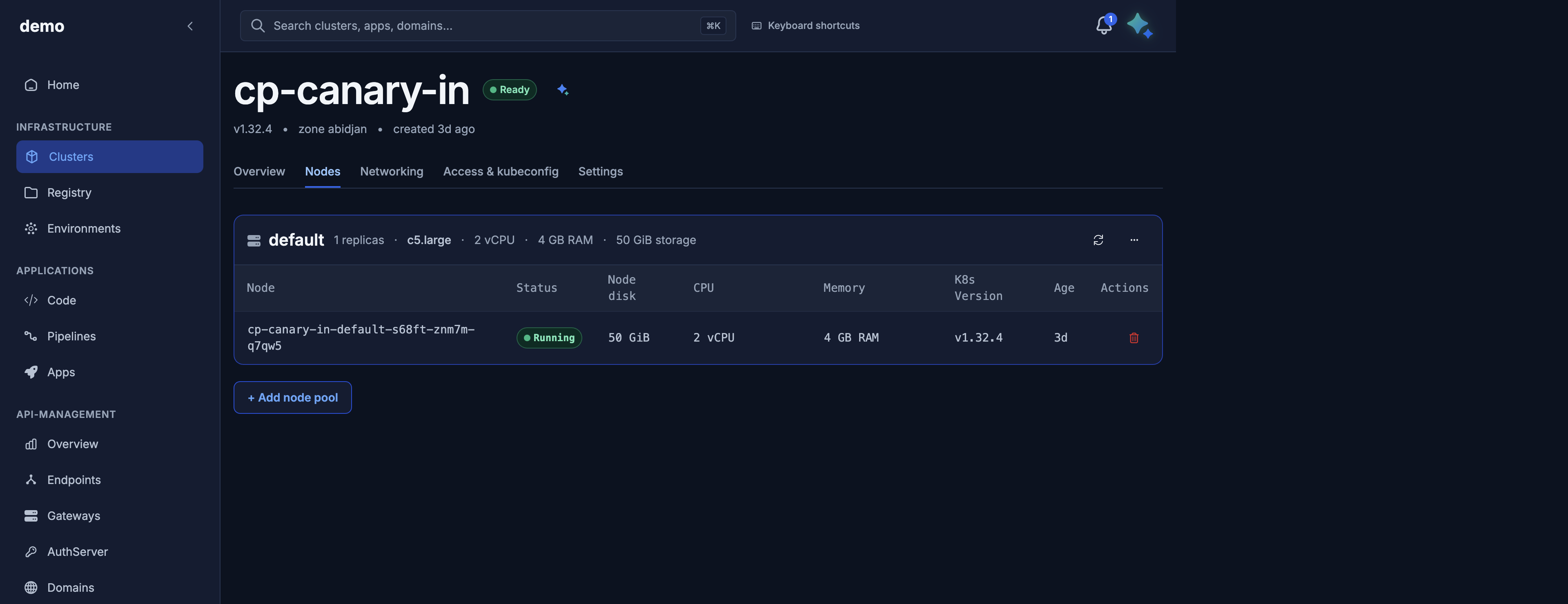
Node pools and nodes
A node pool is a group of workers that share one machine tier. You add, scale, autoscale, and remove pools on a Provisioned cluster. You can also delete a single worker; Door replaces it so the pool's desired count stays the same.
Who can do this: member lists pools and nodes. super_admin adds, patches, removes pools, and deletes a node.
All mutations below return 409 unless phase=Provisioned (including ControlPlaneReady and NodesReady). A second pool operation on the same pool while one is still running is also 409. Different pools may be changed in parallel.
Console: cluster → Nodes (/dks/clusters/<id>/nodes). Maya: “Scale the workers pool on payments-prod to 4.” Approve.
List pools
GET /v1/public/clusters/{id}/node-pools → 200
curl -sS \
"https://dks-api.apps.door.cloud/v1/public/clusters/${CLUSTER_ID}/node-pools" \
-H "Authorization: Bearer $DOOR_TOKEN"
{
"schema_version": "nodepool.public.v1",
"cluster_id": "3f9c1a2e-7b4d-4c58-9e21-5d6f8a0b1c2d",
"items": [
{
"id": "a1b2c3d4-0000-4000-8000-000000000001",
"name": "workers",
"size": "dks.c5.xlarge",
"count": 2,
"auto_scale": false,
"min_nodes": null,
"max_nodes": null,
"labels": {},
"tags": {},
"root_volume_size_gib": 80,
"lifecycle": "active"
}
],
"total": 1
}
GET /v1/public/clusters/{id} also embeds node_pools with the same item shape. Pool list does not embed nodes — use the node routes below.
lifecycle is active or deleting (after a pool delete is accepted, until it is gone).
Add a pool
POST /v1/public/clusters/{id}/node-pools → 202 and the full cluster body (updated node_pools).
PublicNodePoolCreateRequest
| Field | Type | Default | Constraints |
|---|---|---|---|
name | DNS label | — required | Unique among alive pools. Duplicate → 409. |
size | string | — required | Catalog machine tier id. Unknown → 400. |
count | int | 1 | 0–200. count=0 only with auto_scale=true. |
auto_scale | bool | false | |
min_nodes | int or null | null → 1 when autoscaling | ≥ 0 |
max_nodes | int or null | null | Required when auto_scale=true; ≥ min_nodes; count in range. |
labels | object | {} | |
tags | object | {} |
Same autoscaling rules as create. Invalid combination → 422. 402 if prepaid credit cannot cover the extra capacity.
curl -sS -X POST \
"https://dks-api.apps.door.cloud/v1/public/clusters/${CLUSTER_ID}/node-pools" \
-H "Authorization: Bearer $DOOR_TOKEN" \
-H "Content-Type: application/json" \
-d '{
"name": "batch",
"size": "dks.m5.xlarge",
"count": 1
}'
Follow with GET …/state (operations[] shows the pool activity while phase stays Provisioned).
Maya: “Add a node pool named batch on payments-prod with one dks.m5.xlarge.” Approve the confirmation card.
Scale and enable autoscaling
PATCH /v1/public/clusters/{id}/node-pools/{name} → 202 and the cluster body.
PublicNodePoolPatchRequest
Only mutable fields. size is not accepted (immutable). To change tier: add a new pool, wait until it is up, then delete the old one.
| Field | Type | Notes |
|---|---|---|
count | int or omit | 0–200 |
auto_scale | bool or omit | |
min_nodes | int or omit | |
max_nodes | int or omit | |
labels | object or omit | Replaces the stored map when sent |
tags | object or omit | Replaces the stored map when sent |
Omitted keys keep the current row. Sending no fields → 422: at least one of: count, auto_scale, min_nodes, max_nodes, labels, tags.
The handler merges your patch with the current pool, then validates:
| Rule | Error |
|---|---|
auto_scale=true and max_nodes missing (after merge) | 422 max_nodes is required when auto_scale=true |
min_nodes > max_nodes | 422 |
count outside [min_nodes, max_nodes] when autoscaling | 422 |
auto_scale=false and count=0 | 422 count=0 requires auto_scale=true (or use DELETE to remove the pool) |
If you turn autoscaling on without sending bounds, Door fills min_nodes (default 1) and requires max_nodes from you or the existing row.
Optional Idempotency-Key behaves as on create (same key + same patch body replays 202).
# Fixed size: 2 → 4
curl -sS -X PATCH \
"https://dks-api.apps.door.cloud/v1/public/clusters/${CLUSTER_ID}/node-pools/workers" \
-H "Authorization: Bearer $DOOR_TOKEN" \
-H "Content-Type: application/json" \
-d '{ "count": 4 }'
# Turn on autoscaling
curl -sS -X PATCH \
"https://dks-api.apps.door.cloud/v1/public/clusters/${CLUSTER_ID}/node-pools/workers" \
-H "Authorization: Bearer $DOOR_TOKEN" \
-H "Content-Type: application/json" \
-d '{ "auto_scale": true, "min_nodes": 2, "max_nodes": 6, "count": 2 }'
409: cluster not Provisioned, or a pool operation still in flight. 404: unknown pool name (or already deleting). 402: credit gate.
Remove a pool
DELETE /v1/public/clusters/{id}/node-pools/{name} → 202.
The cluster must keep at least one alive pool. Deleting the last pool returns 409. Add a replacement pool first, then delete the old one.
curl -sS -X DELETE \
"https://dks-api.apps.door.cloud/v1/public/clusters/${CLUSTER_ID}/node-pools/batch" \
-H "Authorization: Bearer $DOOR_TOKEN"
The pool's lifecycle becomes deleting until workers are gone.
List nodes
Two reads, same stale-while-revalidate contract. Always 200 with the best-known snapshot (never 202). 409 cluster not ready yet until Provisioned. 404 if the pool name does not exist. 503 if inventory is temporarily unavailable.
| Route | Scope |
|---|---|
GET /v1/public/clusters/{id}/nodes | Every worker on the cluster |
GET /v1/public/clusters/{id}/node-pools/{pool}/nodes | One pool |
Freshness fields on the envelope:
| Field | Meaning |
|---|---|
cold | true on the first read (no snapshot yet). items may be empty. A refresh is queued. |
stale | true when the snapshot is older than the cache TTL. A refresh is queued. |
next_refresh_at | When the background refresh is expected (if one was enqueued). Poll again after that. |
curl -sS \
"https://dks-api.apps.door.cloud/v1/public/clusters/${CLUSTER_ID}/nodes" \
-H "Authorization: Bearer $DOOR_TOKEN"
curl -sS \
"https://dks-api.apps.door.cloud/v1/public/clusters/${CLUSTER_ID}/node-pools/workers/nodes" \
-H "Authorization: Bearer $DOOR_TOKEN"
{
"schema_version": "node.public.v1",
"cluster_id": "3f9c1a2e-7b4d-4c58-9e21-5d6f8a0b1c2d",
"items": [
{
"name": "payments-prod-workers-abc12",
"pool": "workers",
"status": "Running",
"kubernetes_version": "v1.32.4",
"ready": true,
"created_at": "2026-10-01T12:04:00Z",
"deleted_at": null
}
],
"total": 2,
"cold": false,
"stale": false,
"next_refresh_at": null
}
PublicNodeResponse
| Field | Meaning |
|---|---|
name | Worker name as in kubectl get nodes (falls back to the internal worker identity before the node joins). |
pool | Owning pool name, or null. |
status | Customer lifecycle: Pending, Provisioning, Provisioned, Running, Deleting, Deleted, Failed, Unknown. |
kubernetes_version | kubelet version when known. |
ready | Kubernetes Node Ready. |
created_at / deleted_at |
Addresses and provider ids are not exposed. Use kubectl if you need them on the node.
Delete a single node
DELETE /v1/public/clusters/{id}/nodes/{node_name} → 202 PublicNodeDeletePendingResponse.
The pool's declared count does not change. Door replaces the worker so the pool returns to the desired size. Use this to recycle one bad node, not to scale down (use PATCH count or autoscale for that).
node_name must match ^[a-z0-9][-a-z0-9.]{0,252}[a-z0-9]$ or you get 400. The API does not 404 on an unknown name; a bad name fails asynchronously — watch the node list.
409 if the cluster is not Provisioned or another delete for that node is already in flight.
curl -sS -X DELETE \
"https://dks-api.apps.door.cloud/v1/public/clusters/${CLUSTER_ID}/nodes/payments-prod-workers-abc12" \
-H "Authorization: Bearer $DOOR_TOKEN"
{
"schema_version": "node.public.v1",
"cluster_id": "3f9c1a2e-7b4d-4c58-9e21-5d6f8a0b1c2d",
"node_name": "payments-prod-workers-abc12"
}
Poll GET …/nodes until the old name disappears and a replacement appears.
Maya: “Replace node payments-prod-workers-abc12 on payments-prod.”
Labels, tags, and root_volume_size_gib
Pool labels and tags are stored on the pool and returned by the API. They are not applied as Kubernetes node labels (workers are provisioned without extra node labels). To label nodes for scheduling, use kubectl label node (or a DaemonSet/admission policy) after the node is Ready.
root_volume_size_gib is not a request field. It is taken from the catalog tier's spec.disk_gib (for dks.c5.xlarge, 80 GiB). You cannot PATCH it. Changing disk means a new pool with a different size.
Cluster-level tags (string array on the cluster) are separate from pool tags (string maps).
Capacity totals
On GET cluster:
| Field | How it is computed |
|---|---|
total_vcpu | Sum of (tier vCPU × effective nodes) over alive pools. Null if a pool size cannot be resolved. |
total_memory_gib | Same for RAM. |
total_volume_gib | Sum of (root_volume_size_gib × effective nodes). |
| Effective nodes | max_nodes when auto_scale is on and max_nodes is set; otherwise count. |
Use these as planned capacity, not as a live kubectl top reading.
Status code cheat sheet
| Code | Typical cause |
|---|---|
200 | List pools or nodes. |
202 | Add/scale/remove pool or delete node accepted. |
400 | Unknown machine tier; invalid node name. |
402 | Prepaid credit cannot cover the scale. |
403 | Not super_admin (mutations) or not a member (reads). |
404 | Cluster, pool, or (after teardown) cluster gone. |
409 | Not Provisioned; last pool; name clash; operation in flight. |
422 | Empty PATCH; merged autoscaling bounds invalid. |
503 | Node inventory temporarily unavailable. |